
24 Sep How to Talk to a Child About Safety Without Creating Fear?
At Kappa Data, we usually talk about security in very technical terms.
Networks. Cyber threats. Business continuity. Access to infrastructure. Procedures. Emergency situations.
But that day, some of us looked at security from a completely different perspective.
As parents waiting for confirmation that their children were safe.
So we started talking.
What should a child actually know?
What should a parent agree with them in advance?
In an emergency, should they call or send a text message?
What should happen if someone else comes to pick up the child?
Could a family password also help if someone impersonates a relative over the phone?
And most importantly:
How can we talk to a child about all of this so they feel safer afterwards, not more afraid?
See How Much You Already Know
We reached one conclusion quite quickly.
We do not want to start this kind of conversation with:
“What would you do if something bad happened?”
A much better place to start is:
“See how much you already know.”
Because children really do know a lot.
They know who their teacher is. They know who they trust. They can follow instructions. They know where their school and home are. Older children can send a short message. Younger children know that in a difficult situation, they should stay with a trusted adult.
What they need most is someone to calmly help them organize that knowledge.
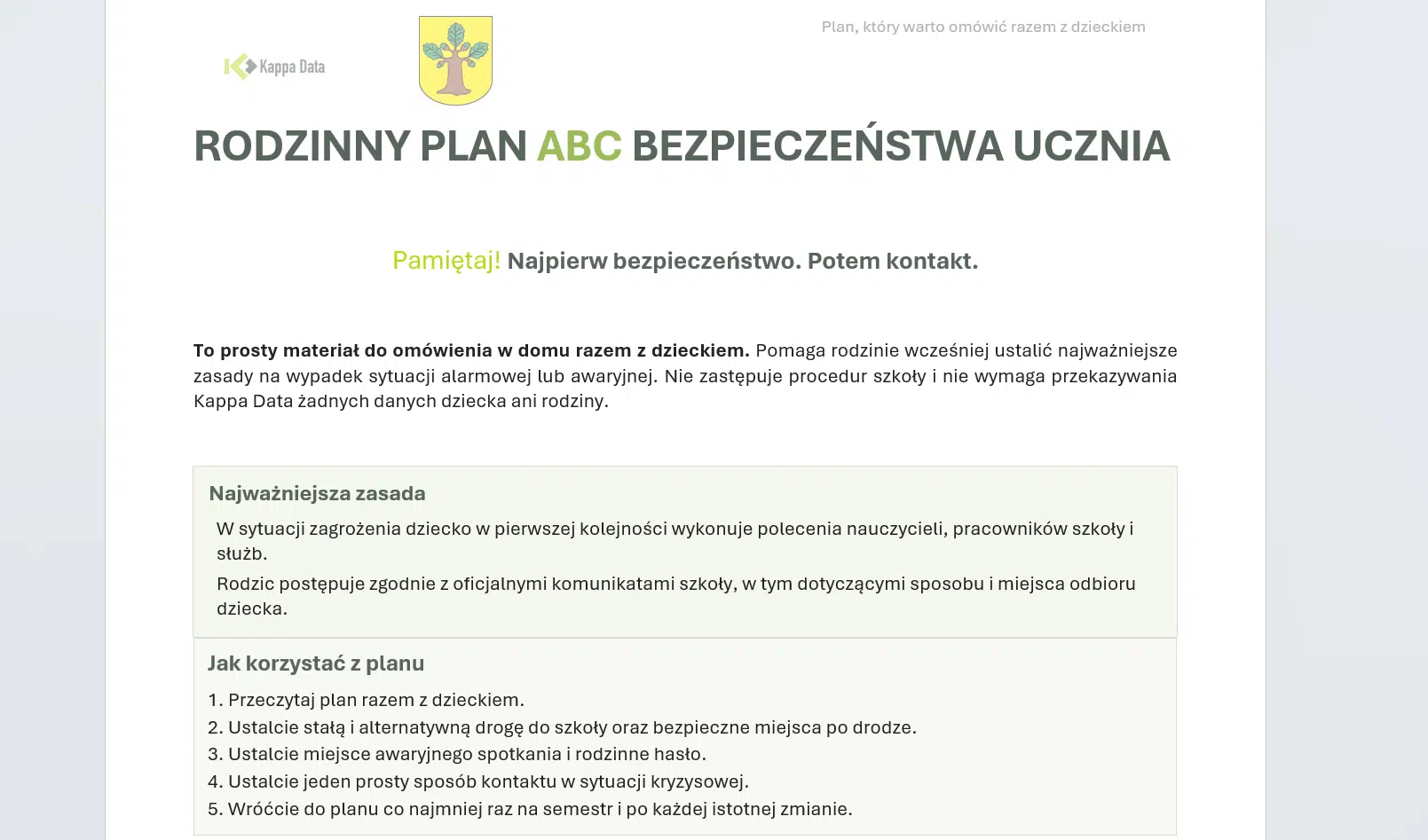
That is how the idea for the Family ABC Student Safety Plan was born.
The plan does not replace school procedures. Its purpose is to help parents have a calm conversation at home and agree a few simple rules with their child in advance.
Na zdjęciu część zespołu Kappa Data z Wiesławem Ordonem - Burmistrzem Miasta i Gminy Nowa Dęba

One Message Instead of Ten Phone Calls
The plan includes a few very simple rules.
The child stays with the teacher. They do not try to look for a parent or sibling on their own. If it is safe to use a phone, one short message is enough instead of making repeated calls:
“I’m safe. I’m at school. I’m waiting.”
The parent, in turn, knows that not receiving an immediate call does not necessarily mean that something is wrong. In a crisis, the mobile network may be overloaded, the child may not have access to their phone, or the school may be moving students to a safe location.
These may seem like small things.
But sometimes it is exactly these small things that give both the child and the parent something clear to hold on to in a difficult moment.
A Family Password That Also Works Online
The plan also includes a family password.
Not only for situations when someone else is supposed to pick up the child.
It can also help when someone calls pretending to be a family member, sends a message from a “new number”, contacts the child through a messaging app, or asks for money, personal data or a code.
The rule is simple:
We do not say the password first. The person who wants to confirm their identity should already know it.
And this is where our two worlds, physical safety and cybersecurity, suddenly came together very naturally.
In the End, We Created a Fridge Card
We did not want to stop at a few pages of text.
So we also created “My Safety Card”.
Five simple rules for a child:
- I stay with my teacher.
- I follow instructions.
- I do not go looking for my family on my own.
- If I can, I send one short message.
- I only leave when it has been confirmed that I can.
And one more:
When I feel scared, I look for an adult I trust.
Because a child does not need to know the entire procedure.
They need to know their next safe step.
Kappa Data Is About Technology. But Safety Starts with People.
We work with cybersecurity, networks and technology.
But our team is made up of more than just specialists.
We are also mums and dads.
On September 17, some of us were simply waiting for a message telling us that everything was okay.
And perhaps that is exactly why this project looks the way it does.
We do not want to create another instruction manual that a parent downloads, saves somewhere and never opens again.
We want to give them a few meaningful minutes of conversation with their child.
A conversation after which the child does not think:
“I need to be afraid.”
But instead:
“I know what to do. I can handle this. The adults have a plan.”
We do not want to frighten children.
We want to prepare them.
And help them believe that they already know and can do a lot.